If you’ve been lucky enough to be in Thailand during the Songkran Festival, you will already know what an incredible event it is. And if you haven’t yet celebrated Songkran in Thailand but are planning to visit, you are in for a treat. You can look at photos and videos to give you an idea of what to expect, but this is an event that has to be experienced in person to fully appreciate it. While the good-natured water fights grab much of the attention, there is so much more to this exuberant Thai festival that everyone should try to experience at least once in their lifetime.

(Photo: Virojt Changyencham / Shutterstock.com)
Celebrating New Year
Songkran is a time when Thai people will wish one another ‘Sawatdee Pii Mai’ (Happy New Year). In Thailand, there are three opportunities to join in with New Year festivities. The Western New Year provides a chance to celebrate and a time to reflect at the start of the new calendar year. Then there is the Chinese New Year and with between 10-15% of the Thai population being of Chinese descent, this is celebrated by many people in Thailand. However, the biggest and best celebrations can be seen during Songkran, the traditional Thai New Year.
When is Songkran?
The word ‘Songkran’ comes from Sanskrit, an ancient language used in Hinduism and Buddhism and refers to an astrological passage. In ancient times, the dates of the Songkran New Year were determined by the solar calendar and the movement of the sun into each of the zodiac houses. The end of a 12-month cycle and the beginning of a new solar year was marked when the sun moved into the Aries sign, which usually occurred in April.
These days, the dates for Songkran are fixed with Thailand celebrating the traditional Thai New Year from April 13-15. Songkran is a nationwide public holiday and the most keenly anticipated holiday of the year.
What are the main Songkran traditions?
Songkran is a time for Thai-style sanuk but is also an event which has a host of traditions attached to it. The cultural importance of Songkran has been formally recognised by UNESCO who have added Songkran in Thailand to their listings for cultural heritage.
Wash away your troubles
Water is prominent in the Songkran traditions. The water symbolically washes away bad luck from the previous year and cleans the way for a fresh start to the new year. The act of throwing water is also a way to encourage fertility and essential rains for rice cultivation.

Family gatherings
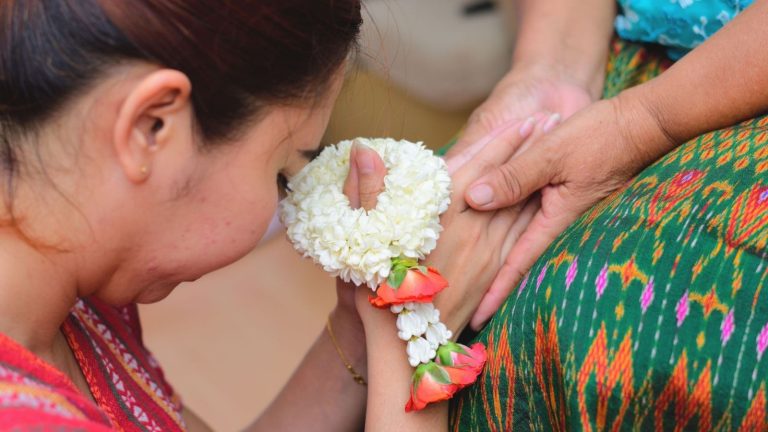
The Songkran holiday period is a time for families. Many Thai people who live or work away from their home province will return to reunite with their families for the Thai New Year. Sons and daughters pay their respects to their parents with a ceremony that involves washing their parent’s feet with scented water (nam ob). Jasmine-scented water is also poured gently over the hands of elders as a mark of respect. Family ancestors are honoured too with families gathering together at the local temple to make merit and pray for the year ahead.

(Photo: ChaiyonS021 / Shutterstock.com)
Cleaning Buddha images
Cleaning Buddha images is one of the most important Songkran traditions. The ritual of Song Nam Phra involves visiting the local temple and gently pouring scented water over the Buddha statue. In many towns and cities, sacred Buddha images are paraded through the streets allowing locals the opportunity to douse them with lustral water.

(Photo: Suphatthra olovedog / Shutterstock.com)
Taking sand to the temple
Carrying sand to the local temple is another key Songkran tradition. This is a way of making merit with the sand formed into stupas (chedi sai) and decorated with colourful pennants. In some areas of Thailand, this tradition has evolved into the crafting of elaborate sand sculptures such as the ones at Bang Saen Beach in Chonburi.

(Photo: puwanai / Shutterstock.com)

(Photo: Theera Disayarat / Shutterstock.com)
Cleaning the home
On Songkran Day (April 13) Thai people will often clean their homes in the morning as they symbolically sweep away any negativity and bad luck from the old year and start with a clean slate for the new year.
Flower garlands
Floral garlands known as phuang malai are another colourful part of the Songkran traditions. Fragrant flowers such as jasmine, white champaca (magnolia) and roses are often used in the garlands which may be presented to relatives as a mark of respect and love.
The flower theme is continued with the floral-print Songkran shirt that is worn by many Thais for the New Year celebrations. The colourful shirts are a practical way to keep cool and show you are in the festive spirit.
Playful water fights
If you happen to be in Thailand during this time, get ready to witness and experience what has been described as the world’s biggest water fight! Embrace the experience and accept any good-natured soaking with a smile. Join in the fun, and let the water wash away your troubles as you experience the joyous spirit of this amazing tradition.
The first day of the event (April 13) and the last day (April 15) are the most intense for water throwing. However, in some regions of Thailand, the water-throwing fun can start a day or two before the official dates. In Chonburi province (including Pattaya) the Wan Lai Festival is incorporated into the Songkran festivities with water-throwing starting earlier and finishing later compared to most other provinces.

(Photo: artapartment / Shutterstock.com)
Get a gentle pasting
During the Songkran festival, it is a tradition in some regions to apply a powder called ‘din sor pong‘ on each other as a way of wishing good luck. This natural talc has traditionally been used to protect against the sun and is often smeared on faces and vehicles.
Respect local culture
Songkran is an amazing event to experience in person and with so much fun being had it’s easy to get carried away. When out celebrating Songkran, respect Thai culture. Pouring water over someone is believed to bring good luck so when you venture out you will get wet. At the same time, some people still have to work and won’t appreciate an unnecessary soaking. If someone asks you not to throw water, please respect their wishes.
In most areas, the water-throwing stops at dusk. There are some exceptions, such as Khao San Road and Silom Road in Bangkok and areas of Chiang Mai where the party continues into the night. However, in most areas, the evening is not the time to be throwing water. Enjoy the party, but use your common sense. This can be a dangerous time to be on the roads, especially for motorbike riders so avoid throwing water at passing motorbikes, even if you see others doing it.

(Photo: nuwatphoto / Shutterstock.com)
Where is the best place in Thailand to celebrate Songkran?
Songkran is celebrated throughout Thailand in mid-April. The festivities can be enjoyed in all parts of the country, although they may vary in intensity and duration from place to place.
Bangkok
Bangkok is quieter than usual during Songkran, as many people take advantage of the extended holiday to visit their families or take a break from the capital. However, those looking for a party can still enjoy lively Songkran activities on Khao San Road and Silom Road.
Chiang Mai
Chiang Mai is renowned for its cultural activities and street parades, along with the mass water fights that take place across the city, making it one of the best places to celebrate Songkran.
Pattaya and Chonburi
Pattaya hosts one of the biggest and wildest Songkran events, which includes the Wan Lai Festival. While the water-throwing usually ends in most parts of Thailand on April 15, Pattaya and other parts of Chonburi province have a final blast of water mayhem on April 19. Visitors to Pattaya can also visit nearby Bang Saen to see the amazing sand sculptures on the beach. However, be prepared for traffic jams leading in and out of Bang Saen during Songkran and the Wan Lai Festival.
Thai islands
If you like the idea of celebrating Songkran, but would prefer to do it more quietly, head to the smaller Thai islands. Songkran is still celebrated but is more restrained compared to the mainland. This makes the islands a good choice if you want to enjoy a more mellow Songkran.
Off the tourist trail
Smaller towns and cities in Thailand can be a great place to celebrate with fewer tourists and more of a local atmosphere. Some destinations hold additional regional festivals at this time of the year such as the Hae Nang Kradan Festival in Nakhon Si Thammarat.
Songkran travel advice
Songkran is a period of busy domestic travel in Thailand. If you plan to travel during this time, it is recommended to book your transportation and accommodation in advance. Buses and trains in and out of Bangkok are often booked out for the days around the long Songkran holidays.