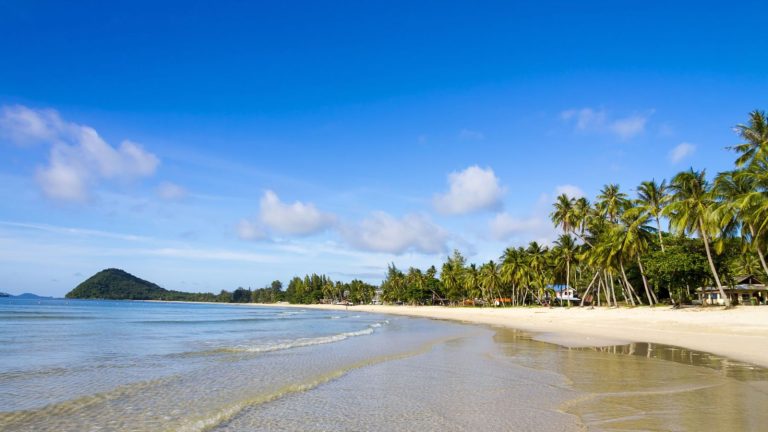
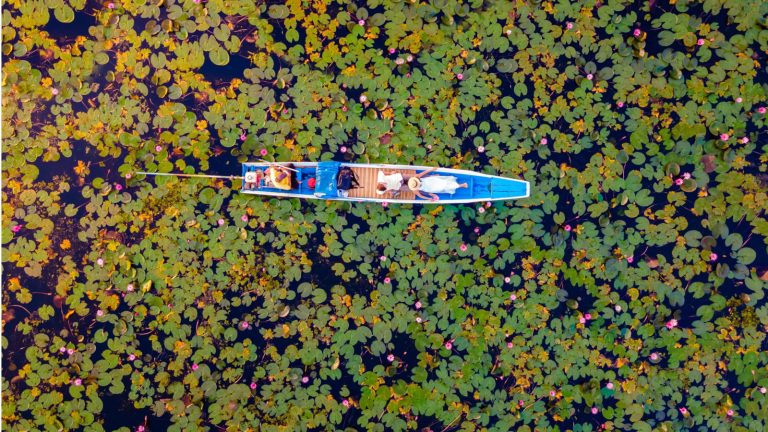
Thailand’s spectacular scenery has attracted filmmakers for decades. From limestone cliffs rising out of emerald seas to ancient temple ruins and jungle-covered mountains, the country’s diverse landscapes have provided the backdrop for everything from James Bond adventures and Hollywood blockbusters to war dramas and action thrillers.

In some productions, Thailand appears as itself. In others, it stands in for neighbouring countries including Vietnam, Laos, Cambodia and even India. Bangkok’s bustling streets, the historic ruins of Ayutthaya, the mountains of Northern Thailand and the islands of the Andaman Coast have all enjoyed their moments on the silver screen.
Whether you’re a film enthusiast or simply looking for inspiration for your next trip, these iconic filming locations offer a fascinating way to explore Thailand. Many have become tourist attractions in their own right, while others remain relatively undiscovered despite appearing in major international productions.
Bangkok
Featured in: The Deer Hunter (1978), Good Morning, Vietnam (1987), The Hangover Part II (2011), Only God Forgives (2013)
We’ve listed a small selection of films above, but few cities in Southeast Asia have appeared on screen as often as Bangkok. Its blend of glittering skyscrapers, ornate temples, bustling markets and vibrant nightlife has made it a favourite with filmmakers seeking both modern urban energy and exotic intrigue.
Perhaps the best-known recent production is The Hangover Part II. Although the film plays fast and loose with Thailand’s geography, it showcases several memorable locations. The rooftop scenes at Sky Bar atop Lebua at State Tower became instantly recognisable to audiences worldwide. At the same time, the movie’s chaotic adventures helped cement Bangkok’s reputation as a city where almost anything can happen.
The darker side of the Thai capital is captured in Only God Forgives, a visually striking crime thriller starring Ryan Gosling. Neon-lit streets, boxing gyms and atmospheric alleyways combine to create a stylised version of Bangkok that is both beautiful and unsettling.
Long before these productions arrived, Bangkok was already playing other roles on screen. In Good Morning, Vietnam, the city doubled for Saigon during the Vietnam War era, while scenes from The Deer Hunter were also filmed here. One of the movie’s most memorable sequences, the notorious Russian roulette scene featuring Christopher Walken, was filmed in Bangkok’s Patpong district.
For visitors today, Bangkok offers countless opportunities to follow in the footsteps of filmmakers. From luxury rooftop bars and riverside hotels to historic neighbourhoods and vibrant street markets, the city remains one of Asia’s most cinematic destinations.
Ayutthaya
Featured in: Kickboxer (1989), Mortal Kombat (1995), Mortal Kombat: Annihilation (1997)
The atmospheric ruins of Ayutthaya Historical Park have provided a dramatic backdrop for several action and martial arts films. As the former capital of Siam, Ayutthaya’s centuries-old temples and crumbling stupas lend themselves perfectly to stories featuring ancient civilisations, warriors and mythical battles.
One of the earliest Hollywood productions to make use of the location was Kickboxer, starring Jean-Claude Van Damme. The cult martial arts film follows a young fighter who travels to Thailand to learn Muay Thai and seek revenge for his injured brother. While filming took place at various locations around the country, Ayutthaya’s historic setting helped establish the movie’s distinctive Thai atmosphere.
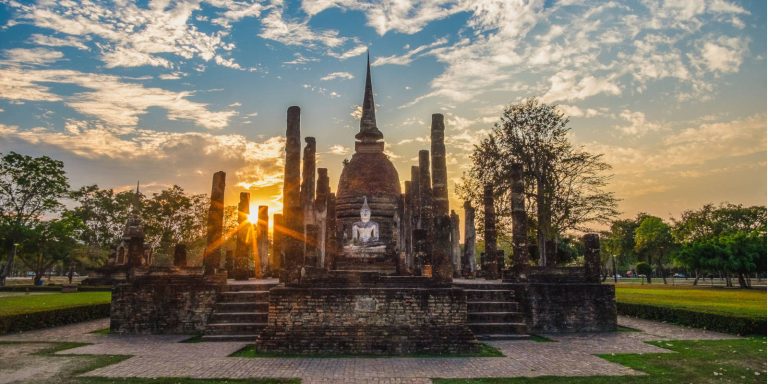
The city’s cinematic credentials were enhanced further when Mortal Kombat used both Ayutthaya and Sukhothai Historical Park to create the fantastical world of Outworld. The impressive ruins provided an ideal setting for the film’s mystical temples and ancient battlegrounds. The sequel, Mortal Kombat: Annihilation, returned to Thailand and featured future action star Tony Jaa working behind the scenes as a stunt performer and double.
Among the most recognisable locations is Wat Chaiwatthanaram, which appears as the Temple of Light in Mortal Kombat. Today, visitors can explore the same temple complex on foot, cycle between the ruins, or take a boat trip around Ayutthaya’s island city while imagining the action sequences filmed here.
Phang Nga Bay
Featured in: The Man with the Golden Gun (1974), Tomorrow Never Dies (1997)
Few film locations in Thailand are as instantly recognisable as the dramatic limestone karsts of Phang Nga Bay. Rising vertically from emerald-green waters, these distinctive islands have become synonymous with James Bond and remain among the country’s most visited attractions.
The location achieved worldwide fame through The Man with the Golden Gun, Roger Moore’s second outing as 007. While the film includes scenes shot in Bangkok and elsewhere in Thailand, it is Phang Nga Bay that left the most lasting impression. The villain Scaramanga, played by Christopher Lee, is based on Ko Khao Phing Kan, an island that has since become universally known as ‘James Bond Island’. Standing just offshore is the needle-shaped limestone pinnacle of Khao Tapu, or Nail Mountain, which featured prominently during the climactic duel between Bond and Scaramanga.
The film transformed an otherwise little-known island into one of Thailand’s most famous landmarks. Today, boat tours from Phuket, Krabi and Phang Nga regularly visit the location, allowing travellers to experience the scenery that captivated cinema audiences more than 50 years ago.
Phang Nga Bay returned to the big screen in Tomorrow Never Dies, another James Bond adventure. Although filming locations were spread across several countries, the bay’s spectacular scenery once again provided a fitting backdrop for high-octane action sequences.
Even for visitors with no interest in James Bond, Phang Nga Bay remains one of Thailand’s most breathtaking natural attractions, combining dramatic landscapes, hidden lagoons and traditional fishing communities such as Ko Panyee.
Krabi and the Phi Phi Islands
Featured in: The Beach (2000), Jurassic World: Rebirth (2025)
Thailand’s Andaman Coast has appeared in countless travel brochures, but it was Hollywood that first introduced many international visitors to its extraordinary scenery. Few destinations have benefited more from cinematic exposure than Krabi and the nearby Phi Phi Islands.
The most famous production associated with the region is undoubtedly The Beach, starring Leonardo DiCaprio. Released in 2000, the film turned Maya Bay on Phi Phi Leh into one of the world’s most sought-after travel destinations. The secluded cove, surrounded by towering limestone cliffs and turquoise water, was presented as a tropical paradise hidden from the outside world.
Although Maya Bay became the film’s defining image, several other Thai locations also appeared. Khao San Road in Bangkok featured as the backpacker meeting point, the waterfall jump sequence was filmed in Khao Yai National Park, and Phuket’s historic On On Hotel was used for some scenes.
The film’s success dramatically increased visitor numbers to Phi Phi, bringing both economic benefits and environmental challenges. In recent years, conservation measures and temporary closures have helped restore the fragile ecosystem, allowing Maya Bay to recover while continuing to welcome visitors more sustainably.
More recently, Krabi returned to the spotlight with Jurassic World: Rebirth. The region’s dramatic landscapes and lush tropical scenery proved ideal for portraying a prehistoric environment. Filming took place around Klong Nam Sai, also known as the Clear Water Canal, where crystal-clear waters wind through dense jungle vegetation.
From hidden lagoons and white-sand beaches to limestone cliffs and mangrove forests, Krabi continues to offer filmmakers a ready-made tropical paradise.
Phuket
Featured in: Heaven & Earth (1993), Bridget Jones: The Edge of Reason (2004), Good Morning, Vietnam (1987)
Phuket’s combination of tropical beaches, historic architecture and easy accessibility has made it one of Thailand’s most popular filming locations.
The island appeared in Oliver Stone’s Heaven & Earth, the final instalment of his Vietnam War trilogy. Like several films in the genre, Thailand was used as a substitute for Vietnam, with Bangkok and Phuket providing a variety of locations. One of the most notable settings is Baan Chinpracha, the elegant Sino-Portuguese mansion in Phuket Town that remains open to visitors today.
Phuket also appears in Good Morning, Vietnam, although much of the film focuses on Bangkok. Thailand’s versatility allowed filmmakers to recreate scenes from wartime Vietnam without leaving the country.
For many viewers, however, Phuket’s most memorable cinematic appearance came in Bridget Jones: The Edge of Reason. Renée Zellweger, Colin Firth and Hugh Grant brought the popular British franchise to Thailand, with filming taking place in both Bangkok and Southern Thailand.
The movie showcases some of the region’s most picturesque scenery, including Phang Nga Bay, the stilt village of Ko Panyee and Nai Yang Beach. While the film takes a light-hearted approach to travel, it provides a delightful glimpse of the landscapes that continue to attract visitors from around the world.
Away from the cameras, Phuket remains one of Thailand’s most diverse destinations, offering everything from historic old-town streets and cultural attractions to luxury resorts and island-hopping adventures.
Chiang Mai
Featured in: Rambo (1988, 2008), American Gangster (2007), Da 5 Bloods (2020), No Escape (2015)
Northern Thailand’s rugged mountains, dense forests and traditional temples have made Chiang Mai and the surrounding region a popular filming location for action films and war dramas. The area’s scenery is remarkably versatile, often standing in for neighbouring countries while retaining its own distinctive character.
The Rambo franchise has a long association with Northern Thailand. Scenes from both Rambo III and Rambo were filmed around Chiang Mai and Lamphun, with famous landmarks such as Wat Phra That Doi Suthep appearing. During production of Rambo (2008), Sylvester Stallone spent extended periods in the city while filming along the Thai-Myanmar border.
American Gangster brought Denzel Washington and Russell Crowe to Chiang Mai. The movie recounts the rise and fall of drug kingpin Frank Lucas, with Northern Thailand portraying key locations connected to the heroin trade. Sharp-eyed viewers may recognise Warorot Market and streets near Tha Phae Gate.
No Escape used Chiang Mai as the primary filming location for its fictional Southeast Asian setting. Starring Owen Wilson and Pierce Brosnan, the thriller was shot extensively around the city and surrounding countryside, with local streets, markets and hotels transformed into the backdrop for a fast-paced political drama. While the film attracted some controversy for its portrayal of the region, it also provided international audiences with striking glimpses of Chiang Mai’s urban scenery and Northern Thailand’s lush landscapes.
More recently, Spike Lee’s Da 5 Bloods used Chiang Mai, Chiang Dao and Doi Suthep-Pui National Park as stand-ins for Vietnam. The lush jungle scenery provided the perfect setting for the story of four veterans returning to Southeast Asia in search of buried treasure and the remains of a fallen comrade.
For travellers, Chiang Mai offers much more than film history. Ancient temples, mountain viewpoints, national parks and vibrant markets make it one of Thailand’s most rewarding destinations, whether you’re a movie fan or not.
Kanchanaburi
Featured in: The Railway Man (2013), The Deer Hunter (1978)
Kanchanaburi’s dramatic wartime history has made it a natural choice for filmmakers exploring stories connected to conflict and survival.
The province is best known internationally for the Death Railway and the Bridge on the River Kwai, both reminders of the hardships endured by prisoners of war during the Second World War. These historical connections provided the backdrop for The Railway Man, starring Colin Firth and Nicole Kidman.
Based on a true story, the film follows former British Army officer Eric Lomax, who was tortured while working on the Death Railway as a prisoner of war. Decades later, he returns to Thailand to confront one of the men responsible for his suffering. Many scenes were filmed in and around Kanchanaburi, adding authenticity to the emotional story.
The province also appeared in The Deer Hunter. Although the film is primarily associated with Vietnam, Thailand was used extensively during production. One of the movie’s most memorable locations was Sai Yok, where a riverside prisoner-of-war camp was constructed for several dramatic scenes.
Today, visitors can explore the area’s wartime museums, railway stations, caves and national parks while also enjoying the spectacular natural scenery that surrounds them.
Hua Hin
Featured in: The Killing Fields (1984)
Although better known today as a seaside resort and royal retreat, Hua Hin played a small but significant role in one of the most acclaimed films ever made about Southeast Asia.
The Killing Fields tells the powerful true story of Cambodian journalist Dith Pran and New York Times reporter Sydney Schanberg during the Khmer Rouge era. The film won multiple Academy Awards and remains one of the most important historical dramas set in the region.
Because filming in Cambodia was not possible at the time, Thailand was used extensively as a substitute. Various locations across the country stood in for Cambodia, with Hua Hin among those selected for filming.
While the town’s appearance in the film is less well known than some of Thailand’s other movie locations, it forms part of a wider story of how the country’s landscapes have repeatedly doubled for neighbouring nations in major international productions.
Today, Hua Hin offers visitors a completely different atmosphere, combining long sandy beaches, seafood restaurants, golf courses and royal heritage.
Mae Hong Son
Featured in: Air America (1990)
Set among the mountains of Northern Thailand, Mae Hong Son has some of the most dramatic scenery in the country. Its remote valleys, winding roads and mist-covered peaks have often been used to represent neighbouring Laos and Myanmar on screen.
One of the best-known examples is Air America, starring Mel Gibson and Robert Downey Jr. Set during the Vietnam War, the film tells the story of a covert CIA operation operating in Laos. Thailand’s mountainous northern frontier provided the perfect substitute for the remote landscapes depicted in the movie.
Mae Hong Son’s scenery features heavily throughout the film, with the province’s rugged terrain helping to create a convincing sense of isolation and adventure. One particularly memorable scene takes place above Chong Kham Lake in Mae Hong Son town, where Mel Gibson’s character gives Robert Downey Jr.’s character an unforgettable helicopter ride.
The film highlights the natural beauty of a province that remains one of Thailand’s least visited destinations. Travellers who make the journey today are rewarded with mountain viewpoints, traditional villages, beautiful temples and some of the country’s most scenic roads.
Ubon Ratchathani
Featured in: Alexander (2004)
At first glance, Thailand’s northeast may seem an unlikely stand-in for ancient India, but director Oliver Stone thought otherwise when filming Alexander.
The epic historical drama stars Colin Farrell as Alexander the Great and traces the military campaigns that created one of history’s largest empires. To recreate parts of the Indian subcontinent, Stone selected locations along the Mekong River in Ubon Ratchathani province.
The broad river landscapes and untamed scenery of Thailand’s eastern frontier provided an impressive backdrop for the film’s large-scale battle scenes. Additional filming also took place in Saraburi Province, with soldiers from the Royal Thai Army assisting as extras.
Although Alexander received mixed reviews from critics, it remains one of the biggest Hollywood productions ever filmed in Thailand.
For visitors, Ubon Ratchathani offers a very different experience from Thailand’s beaches and islands. Highlights include the Mekong River, Pha Taem National Park, ancient rock paintings and a fascinating blend of Thai, Lao and Khmer cultural influences.