Whether you are interested in history or not, a visit to Sukhothai Historical Park is a memorable experience. Situated approximately midway between Bangkok and Chiang Mai, a visit to Sukhothai is a journey through Thailand’s past. The peaceful rural landscape is scattered with atmospheric ruins and historic monuments, making it a rewarding destination for travellers with an interest in culture and history.

Often described as a golden age of Thai civilisation, the legacy of Sukhothai (1238–1438) laid the foundations for modern Thai identity. From language and religion to art and governance, the influence of this early kingdom can still be felt today.
History of Sukhothai
During the 13th century, Thailand as we know it today had not yet come into existence. Large parts of the region were under the control of the powerful Khmer Empire, while other areas were independent kingdoms. In 1238, Sukhothai broke away from Khmer influence and established itself as an independent state. Although other Thai kingdoms existed further north, Sukhothai’s rapid rise was remarkable. Its name, meaning ‘Dawn of Happiness’, reflects its enduring reputation as the first capital of Thailand.
King Ramkhamhaeng
Much of Sukhothai’s success is attributed to King Ramkhamhaeng, whose reign from 1278 to 1298 marked the kingdom’s peak. Under his leadership, Sukhothai expanded its territory to include areas of present-day Laos, with Luang Prabang and Vientiane coming under its control. This period saw a flourishing of the arts, and King Ramkhamhaeng is widely credited with creating the Thai script still in use today, earning him recognition as the ‘Father of the Thai Language’. After his death, Sukhothai’s influence gradually waned as Ayutthaya rose to prominence further south.

(Photo: Roy Cavanagh)
Sukhothai Old City
Even for visitors who are not deeply interested in history, Sukhothai Historical Park is an impressive place to explore. Located in Muang Kao (the Old City), around 20 minutes from modern Sukhothai town, the park’s tranquil setting enhances the experience. Motor vehicles are prohibited in the central zone, and the surrounding countryside is quiet and flat, making cycling one of the most enjoyable ways to get around. A tram service operates within the central area, while samlor (tuk-tuks) can be hired for sites located further afield.

Park zones
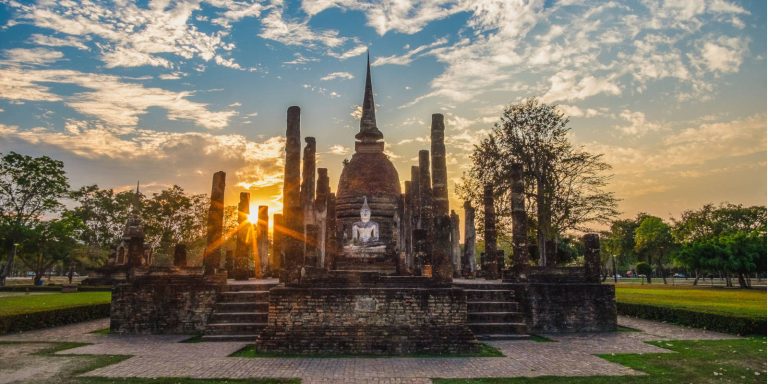
The Historical Park is divided into several zones, with the most significant ruins concentrated in the central section. Notable temples include Wat Mahathat and Wat Si Sawai. Late afternoon is an especially rewarding time to visit, when soft light bathes the ruins and the sun sets behind Wat Mahathat, the former spiritual heart of the Sukhothai kingdom.
A gentle ride east leads to Wat Si Chum, home to a vast seated Buddha image. In the northern zone, Wat Saphan Hin stands on a hilltop and features a towering standing Buddha overlooking the surrounding plains.

For historical context, the Ramkhamhaeng National Museum, near the park entrance, provides a useful introduction to the kingdom’s history and archaeology.
UNESCO World Heritage Site
Sukhothai is one of eight locations in Thailand listed as a UNESCO World Heritage Site. The United Nations Educational, Scientific and Cultural Organisation (UNESCO), recognises places in the world that “are of outstanding universal value to humanity and as such, have been inscribed on the World Heritage List to be protected for future generations to appreciate and enjoy.”

The UNESCO listing is for the “Historic Town of Sukhothai and Associated Historic Towns”. Travellers with extra time can also explore nearby Si Satchanalai and Kamphaeng Phet, both of which form part of the same UNESCO World Heritage listing as Sukhothai and offer further insight into this formative era of Thai history.
Loy Krathong
Thai folklore links the origins of Loy Krathong to Sukhothai, and the Historical Park is widely regarded as one of the best places in the country to experience this enchanting festival, which takes place each November.

At other times of the year, visitors can enjoy a smaller-scale light and sound show celebrating Sukhothai’s heritage. Held on the first Friday of each month from February to early September, these free performances take place in front of Wat Sa Si. The show typically begins in the early evening, featuring fireworks and traditional cultural displays.
How to get around the park
Sukhothai Historical Park is spread out, and the best way to enjoy it is by bicycle. Flat terrain, wide paths, and lots of scenic stops make cycling the easiest and most fun option. You can rent bikes near the park entrances or in nearby Old Sukhothai.

A tram service operates with set routes and is a convenient option if you want to conserve energy in the heat or you’re short on time.
If you’re staying in New Sukhothai (the modern town) or want to combine far-flung ruins with lunch stops, hiring a tuk-tuk for a half-day loop can be very efficient.
Practical tips for visitors
The park is made up of several zones (e.g. central, northern and eastern) with a separate admission fee applying to each zone. Allow yourself ‘slow time’ and don’t rush every temple like a checklist. The magic of Sukhothai is taking your time to appreciate the history and peaceful surroundings.

Whichever zones you decide to visit, dress respectfully. Even though these are ruins, they remain sacred spaces. Knee-length shorts/dress are OK, and shoulders should also be covered when walking around the ancient ruins.

Midday heat can be intense, and early mornings and later afternoons are better times for exploring. Whatever time of day you visit, carry water and use sun protection.
If you’re cycling, plan your day so you aren’t stranded once it gets dark. Although the central zone can still be explored in the early evening, and Wat Mahathat is a great place to watch the sunset, there is limited lighting on the roads in the northern and eastern zones.
How to get to Sukhothai Historical Park
Bangkok Airways sells flights from Bangkok to Sukhothai (Sukhothai Airport/THS). From the airport, you’ll continue by taxi/transfer to either New Sukhothai or Old Sukhothai (near the park).
Although there is no direct train service to Sukhothai, you can travel by train from Bangkok or Chiang Mai to Phitsanulok. From here, you can transfer by local bus for the 1.5-hour journey to Sukhothai.
Long-distance buses run from Bangkok and Chiang Mai to Sukhothai and can be a straightforward option if you don’t mind a longer ride.